



תקציר
Free Trade Agreements | UnitedXP Israel has signed free trade agreements with major economies. Keywords: Israel free trade agreements, EFTA Israel, Canada Israel agreement, UK Israel agreement, rules of origin, certificate of origin, customs duty exemption, customs brokerage, UnitedXP, Foreign Trade Administration. FAQ: Free Trade Agreements & Customs | UnitedXP Everything about EFTA, Canada, UK, rules of origin, and how UnitedXP saves you customs duties.
Free Trade Agreements: How UnitedXP Saves Customs Duties Using EFTA, Canada & UK
Israel as a Free Trade Powerhouse
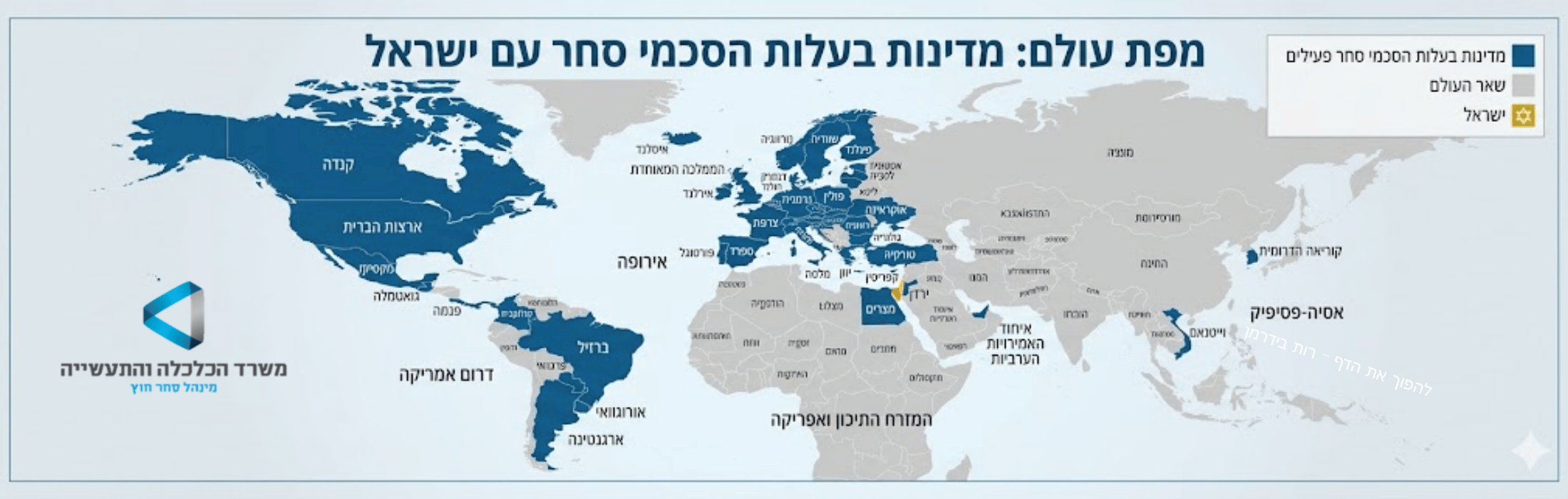
Israel currently has 16 Free Trade Agreements (FTAs) with 48 countries and trade blocs, including the EU, EFTA, and Mercosur. These agreements cover about two‑thirds of Israeli exports and nearly 60% of imports. Many product categories are eligible for full customs exemption or substantial reduction. However, regulatory complexity prevents many companies from realizing these benefits. The gap between eligibility and actual utilization is estimated at 15‑30% per transaction, depending on market and product. The annual loss from unused preferences amounts to billions of shekels.
The Ministry of Economy – Foreign Trade Administration is responsible for negotiating these agreements, publishing trade barriers reports, and updating rules of origin. By working closely with the Foreign Trade Administration, UnitedXP implements these agreements in practice, turning theoretical benefits into real savings for clients.
Key Agreements: EFTA, Canada, and the UK
| Agreement | Countries / Bloc | Signed | Effective | Main Benefit |
|---|---|---|---|---|
| EFTA-Israel FTA | Switzerland, Norway, Iceland, Liechtenstein | 17 Sep 1992 | 1 Jan 1993 | Full exemption for all industrial goods |
| Canada-Israel FTA | Canada | 31 Jul 1996 | 1 Jan 1997 | Full exemption for industrial goods; reductions for agriculture |
| UK-Israel Trade Agreement | United Kingdom | 18 Feb 2019 | 1 Jan 2021 | Rollover of EU agreement terms |
| US-Israel FTA | United States | 1985 | 1985 | Full exemption for industrial goods |
EFTA – Gateway to Europe
The EFTA-Israel agreement, signed in 1992 and effective in 1993, eliminates customs duties on all industrial goods. It creates “EFTA‑EU parity”, meaning identical conditions to those under the EU agreement. Agricultural protocols were updated bilaterally in 2018 and entered into force in August 2021. For an Israeli importer, this means duty‑free import of products from Switzerland, Norway, Iceland, and Liechtenstein – provided the goods meet the rules of origin (Protocol B).
Practical example: medical devices, pharmaceuticals, fine chemicals, electronics, and machinery parts from EFTA countries can enter Israel completely duty‑free. However, EFTA rules of origin follow the Pan‑Euro‑Med model, which includes product‑specific “list rules”. Without a precise analysis of inputs, an importer may inadvertently pay full duty. UnitedXP knows how to classify each product against the rule lists, prepare the correct certificate of origin (EUR.1 or exporter declaration), and save thousands of shekels per container.
Canada – The North American Partner
The Canada-Israel FTA was signed on 31 July 1996 and entered into force on 1 January 1997. It is a comprehensive agreement providing duty‑free treatment for all industrial goods, plus significant reductions on certain agricultural products. Unlike more modern agreements, this one has not been substantially updated, so its rules of origin are stricter than the European model. Nevertheless, trade between the two countries has grown steadily. In 2025‑2026, modernization talks are underway. Meanwhile, UnitedXP applies the current agreement to help Israeli importers bring high‑tech equipment, medical devices, and raw materials from Canada at reduced cost.
The UK post‑Brexit: Continuity Agreement
After the UK left the European Union, a new agreement was urgently needed. On 18 February 2019, the Trade and Partnership Agreement between Israel and the UK was signed, effective 1 January 2021. It largely replicates the terms of the Israel‑EU Association Agreement, with minor adjustments. As a result, all industrial goods (chapters 25‑97) that meet the rules of origin are eligible for full duty‑free treatment when imported from the UK to Israel and vice versa. For Israeli importers, this is an opportunity to bring agricultural products, machinery, chemicals, and more from the UK at competitive prices.
Important: The UK is a signatory to the Pan‑Euro‑Med Convention. A correct declaration of origin requires analyzing the percentage of European components and the manufacturing process. UnitedXP assists clients in preparing preference documents, aligning them with the updated Israeli Customs Tariff, and conducting ongoing checks with the Tax Authority.
Rules of Origin: The Criterion that Decides Duty
Rules of Origin determine the “economic nationality” of a product. Only a product originating in a signatory country qualifies for preferential treatment. The criteria fall into three main types: (1) Wholly obtained – products grown or extracted entirely in the territory; (2) Change in tariff classification – the final product falls under a different HS chapter than its components; (3) Local value added – a specific percentage of the product’s value originates in the member country. The challenge is that each agreement has its own unique rules. Misunderstanding them can lead to full duty payment, fines, and even clearance delays.
UnitedXP specialises in interpreting rules of origin. The company helps clients prepare Certificates of Origin, correctly label products, and maintain proper documentation for customs audits. In doing so, UnitedXP turns regulatory complexity into savings of tens of thousands of shekels per year.
UnitedXP’s Role in Maximising Trade Agreement Benefits
As a company combining international freight forwarding and customs brokerage, UnitedXP serves as the central channel for realising preferences. Its local and international team analyses the supply chain, identifies opportunities for duty preference, and manages all required paperwork with the Foreign Trade Administration and Customs. UnitedXP not only implements existing agreements but also stays up‑to‑date with trade barriers reports published by the Ministry of Economy, guiding clients through new trade obstacles. The advantage is clear: clients enjoy lower‑cost imports and exports, with reduced legal and bureaucratic risk.
Conclusion: Practical Knowledge Saves Real Money
Israel’s free trade agreements are a strategic asset. Their economic potential – especially with EFTA, Canada, and the UK – is enormous. But without deep understanding of rules of origin, accurate documentation, and cooperation with the Foreign Trade Administration, the benefits may remain on paper. UnitedXP is proud to help Israeli businesses realise the full potential of trade agreements. Contact us for an initial consultation: we will analyse which of your products qualify for duty exemption and implement the right agreement for you.
Keywords: Israel free trade agreements, EFTA Israel, Canada Israel agreement, UK Israel agreement, rules of origin, certificate of origin, customs duty exemption, customs brokerage, UnitedXP, Foreign Trade Administration.
Bibliography
Glossary (English‑Hebrew)
FAQ: Free Trade Agreements & Customs Duty Savings
Everything about EFTA, Canada, UK, rules of origin, and how UnitedXP saves you customs duties.
A Free Trade Agreement (FTA) is a treaty between countries that sets preferential trading conditions. Typically, FTAs eliminate or reduce customs duties on goods originating in one of the member countries. For example, under the EFTA agreement, an Israeli importing machinery from Switzerland pays no duty – provided the goods meet the rules of origin.
The main agreements today are: EFTA (Switzerland, Norway, Iceland, Liechtenstein), Canada-Israel, UK-Israel (post‑Brexit), and the US-Israel agreement. All three provide full duty exemption on all industrial goods, subject to meeting rules of origin.
Rules of Origin determine whether a product truly “originates” in a signatory country. Two main criteria: (a) change in tariff classification – the final product falls under a different HS chapter than its components; (b) local value added – at least 30‑40% of the product’s value comes from the FTA country. Without meeting the rules, no preference applies.
The EFTA agreement was signed in 1992 and entered into force in 1993. It grants full duty exemption on all industrial goods traded between Israel and Switzerland, Norway, Iceland, and Liechtenstein. It also uses Pan‑Euro‑Med rules of origin, which facilitate cumulation with the EU. Many companies save tens of thousands of shekels annually through this agreement.
Yes. On 1 January 2021, the UK-Israel Trade and Partnership Agreement entered into force, preserving all preferences that existed under the EU framework. Industrial goods originating in the UK (or Israel) are fully duty‑free, subject to a valid certificate of origin (EUR.1 or exporter declaration). UnitedXP helps adapt to the new requirements.
For most industrial goods – yes, full exemption. However, the rules of origin in the Canada-Israel FTA (1997) are stricter and not based on the Pan‑Euro‑Med model. A thorough analysis of Canadian content is required. Some agricultural products only receive partial reductions, not full exemption. UnitedXP performs a preliminary mapping and prepares the required documents.
A Certificate of Origin is an official document, usually issued by a chamber of commerce or other competent authority, certifying the origin of goods. Without a valid certificate and digital signature, customs will not grant preferential duty treatment. In Israel, certificates exist for conformity, EFTA, the US, and others. UnitedXP assists in rapid issuance from authorised bodies.
UnitedXP combines international freight forwarding and customs brokerage. Its team analyses the product against rules of origin, determines which agreement offers the best benefit, prepares the certificate of origin, affixes digital signatures, and files a preferential customs declaration. The result: clients pay less duty – sometimes zero – and enjoy a more competitive landed cost.
This is a quarterly or annual report published by the Foreign Trade Administration, describing regulatory, customs, and bureaucratic obstacles encountered by Israeli exporters in target markets. The report helps the government remove barriers and helps companies prepare in advance. UnitedXP monitors these reports and advises clients on how to handle each specific obstacle.
In principle, a small company can do its own clearance and prepare certificates of origin. In practice, the complexity of origin rules, the risk of errors, and the need for digital signatures cause most small companies to either miss out on preferences or face fines. Working with UnitedXP repays the investment many times over while avoiding bureaucratic risks.