
תקציר
The Future of Customs Brokerage in Israel: Toward World Gate and AI Integration | UnitedXP August 2026 | Reading time: 12 minutes | Technology, Customs, AI, Regulation Customs brokerage in Israel has been undergoing a quiet yet profound revolution in recent years. This article will examine the central system – World Gate, the integration of AI into customs processes, the accompanying regulatory changes, and the profile of the customs broker of the future. Ultimately, customs brokerage in Israel 2026 is a certificate of insurance for…
The Future of Customs Brokerage in Israel: Toward World Gate and AI Integration
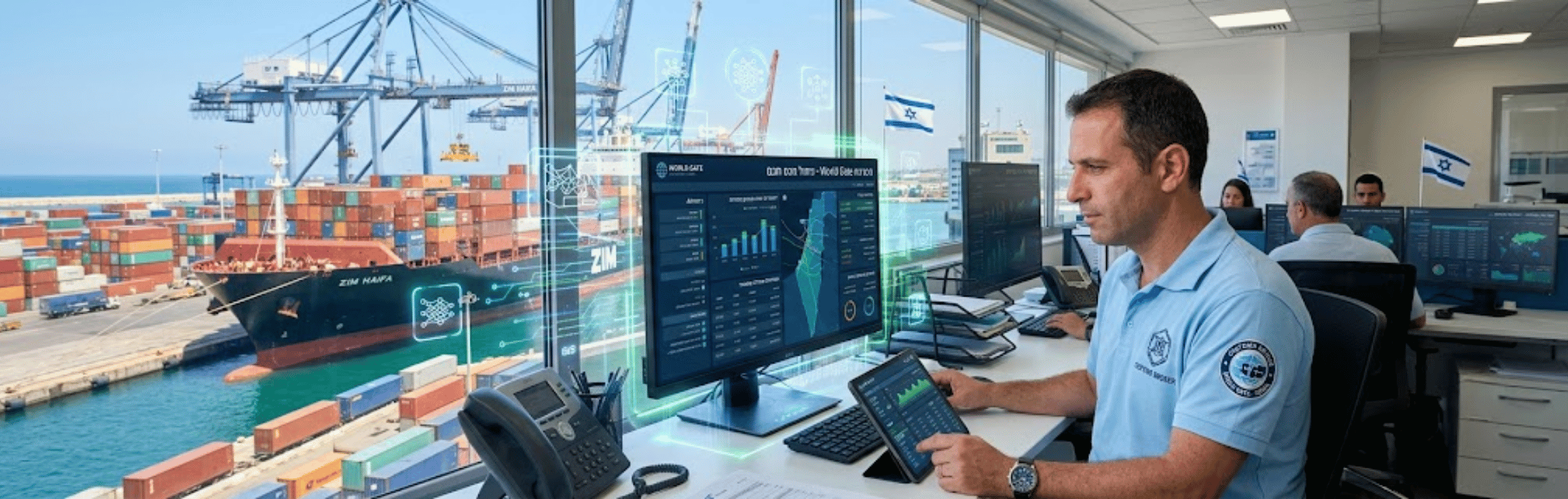
Customs brokerage in Israel has been undergoing a quiet yet profound revolution in recent years. The transition from manual, paper-based processes to a fully digital system is no longer a futuristic vision – it is the reality of 2026 [1]. At the center of this revolution stands the "Ma'am" system (World Gate or Shaar Olami), Israel's central cloud-based platform for managing international trade, which has replaced the paper-based processes that were prevalent until about a decade ago [1].
However, beyond digitization, an even more fundamental change is on the horizon: the integration of artificial intelligence (AI) for risk management, automated product classification, and fraud detection. Israeli startups such as AiDock and CargoSeer are leading this technological wave, with some already being acquired by major American corporations [5][6]. This article examines the future of customs brokerage in Israel in light of these developments, and analyzes how importers, exporters, and customs brokers will need to prepare for the new era.
The technological revolution in customs brokerage is not occurring in a vacuum. It is driven by economic, regulatory, and technological factors converging to create a paradigm shift. On one hand, customs authorities worldwide are grappling with massive growth in international trade – billions of parcels, containers, and shipments crossing borders each year. On the other hand, budgets and personnel are not growing at the same rate. Artificial intelligence offers a solution: automation of inspection processes, rapid anomaly detection beyond human capability, and reduced reliance on expensive, slow manual labor.
In Israel, the combination of advanced technology and regulatory complexity creates a unique opportunity. Israel, known as the "Startup Nation," is home to hundreds of technology companies, some already operating in the international trade space. At the same time, the Israeli business sector – particularly importers and exporters – still faces challenges in adapting to new technologies, alongside increasing regulatory burdens.
This article will examine the central system – World Gate, the integration of AI into customs processes, the accompanying regulatory changes, and the profile of the customs broker of the future. It will also present key challenges on the path to full implementation of new technologies, and practical insights for importers and exporters.
1. World Gate – Israel's Next-Generation Customs Platform
The "Ma'am" system (World Gate) is a central cloud platform that manages all aspects of international trade in Israel [1]. The system, officially launched on January 14, 2018 following a pilot in 2015, connects the Israel Customs Authority with relevant government ministries: the Ministry of Health, the Ministry of Agriculture, the Ministry of Economy, and the Standards Institute [1]. This connection enables a "Single Window Procedure" for submitting all required documents to obtain approvals [1].
The system is available 24/7 with a telephone support center on Sundays through Thursdays from 8:00-22:00 [1]. It allows tracking of application status and significantly reduces clearance times.
1.1 The Importer's Declaration – The Central Digital Document
At the heart of the system is the "Importer's Declaration," also known as the "Importer's Commitment" [1]. This is a digital form that serves as official proof of payment of import duties, and is completed by the customs broker or directly by the importer through the World Gate system [1]. The shift to digital declarations replaced physical forms and enabled faster processing of thousands of transactions daily [2].
According to the guidelines, the importer is required to declare value, classification, and supplier information. Errors in the declaration can delay customs clearance and lead to fines. The system allows online submission using a smart card and electronic signature [1].
Another significant innovation is the system's ability to retrieve information about foreign suppliers registered in World Gate, thereby facilitating declaration completion [1].
2. Artificial Intelligence in Customs Brokerage – The Real Revolution
While World Gate provides the digitization infrastructure, artificial intelligence is what is expected to change the very nature of the profession. The system has undergone continuous upgrades since its launch, including the integration of AI for risk management [1]. However, the use of AI extends far beyond that.
2.1 AI-Based Fraud Detection and Risk Management
One of the most promising areas is customs fraud detection. Machine learning models can analyze millions of import declarations in real time, identifying suspicious patterns that a human would miss [3]. The system examines parameters such as declared value, HS code, seller identity, buyer history, shipping routes, and more.
In Israel, the decision to double the personal import exemption from $75 to $150 (alongside a parallel move to raise VAT to 18%) creates a new challenge [3]. As more packages fall below the exemption threshold, enforcement shifts from container inspection to transaction data analysis. Fraud detection at this scale is a problem well-suited to machine learning solutions [3].
2.2 Automation of Product Classification and Document Processing
Another significant area is product classification according to HS (Harmonized System) codes. This is a complex task requiring substantial professional knowledge, and classification errors can cost importers thousands of shekels. Companies like AiDock have developed platforms that use AI to process and understand import documents, including verification, product classification, and adaptation to changing regulations [6].
AiDock, founded in 2018 and having raised $19.5 million, specializes in automating customs brokerage processes. Its platform uses intelligent learning algorithms to adapt to global and regulatory changes, enabling clients to automate administrative tasks and redirect time to customers [6].
2.3 X-Ray Image Analysis – CargoSeer
CargoSeer, founded in 2023 in Tel Aviv, developed an AI-based platform for automated analysis of container X-ray images, aimed at improving inspection processes and decision-making by customs authorities [5]. The company was acquired in January 2026 by BigBear.ai Holdings for $5 million, reflecting the growing interest in these technologies among major American corporations [5].
Leading Israeli AI Companies in the Customs Space
3. Regulatory Changes and Their Implications for Customs Brokers
The technological revolution is occurring against the backdrop of significant regulatory changes that are reshaping the customs broker's role:
3.1 Food Import Reform
The Israel Customs Authority, in collaboration with the National Food Authority at the Ministry of Health, has published detailed guidelines for importing food and sensitive products [4]. The guidelines distinguish between "regular food" (requiring only an online importer declaration) and "sensitive food" (requiring prior import approval) [4].
Sensitive food includes animal products, infant formula substitutes, basic foods, dietary supplements, and certain frozen foods. Sensitive materials such as hazardous waste or pesticides also require approval from the Ministry of Agriculture and the Ministry of Environmental Protection [4].
3.2 Transfer of Responsibility to the Importer
Israel Customs Authority guidelines emphasize that responsibility for data accuracy in the importer's declaration rests with the importer themselves [1]. This reinforces the need for professional customs brokers who can help importers navigate regulatory complexity and avoid errors.
Regulatory Burden on Israeli Importers – 2026
4. What Will the World of Customs Brokerage Look Like in 5 Years?
The combination of three factors – digitization, AI, and regulatory changes – is expected to dramatically transform the customs brokerage industry:
4.1 The Customs Broker as a Data Analyst
The traditional customs broker, who mainly dealt with form-filling and bureaucratic navigation, will become a data analyst. They will need to understand AI systems, interpret their results, and provide clients with strategic insights based on data [6].
4.2 Real-Time Personalized Service
Automation will allow customs brokers to free up time for their clients and offer real-time personalized service. AI systems can provide alerts on regulatory changes, recommend optimal classification strategies, and identify savings opportunities [6].
4.3 Integration with Smart Supply Chains
Customs systems will seamlessly integrate with importers' supply chain management systems. Companies like AiDock are already moving in this direction, offering platforms that adapt to global regulatory changes [6].
4.4 AI-Based Enforcement
Customs authorities will gradually shift to an AI-based enforcement model, where most shipments are automatically released, and only those flagged as suspicious by the algorithm undergo manual inspection [3]. This will require importers to maintain perfect data accuracy, as minor errors could cause significant delays.
5. Challenges on the Road to the New Era
Despite the enormous potential, the transition to the AI era is not without challenges:
- Algorithmic Bias: Machine learning models can perpetuate existing biases if trained on historical data that contains discrimination. For example, if shipments from certain countries were historically inspected more frequently, the algorithm may continue to flag them disproportionately.
- Data Privacy: AI implementation requires collecting large volumes of data, including sensitive information about businesses and individuals. Mechanisms are needed to protect privacy while maintaining enforcement capabilities.
- Workforce Training: Customs brokers will need significant professional retraining to remain relevant in the digital age. This includes basic understanding of AI, data analysis, and the ability to work with complex systems.
- Regulatory Compliance: The use of AI in government systems requires transparency and explainability of algorithmic decisions. An importer flagged as suspicious is entitled to understand why, and the system must be able to explain the decision in human language.
- Implementation Costs: Transitioning to advanced AI systems involves high costs, both for customs authorities and for small and medium-sized businesses that may struggle to meet new technological requirements.
Conclusion: The Customs Broker in the AI Era
Customs brokerage in Israel is in the midst of a profound technological revolution. The World Gate system has already changed the way cargo clearance is conducted, and AI threatens to transform the very essence of the profession. Customs brokers who adapt to the new era – by acquiring technological skills, understanding AI systems, and providing strategic insights – will remain valuable assets for importers and exporters. Those who resist change will find themselves replaced by algorithms.
For importers and exporters, the message is clear: the customs broker of the future is not the one who knows how to fill out forms, but the one who knows how to extract wisdom from data, navigate changing regulatory complexity, and translate all of this into a competitive advantage. In an era where data is the most valuable asset, the ability to analyze it and extract actionable business insights becomes the central skill.
Practical recommendations for importers and exporters for the new era:
- Investment in Digital Training: Train shipping and customs teams to work with World Gate and AI tools.
- Choosing Technology Partners: Choose customs brokers and logistics providers who invest in AI technologies and offer advanced digital solutions.
- Data Accuracy: As AI systems become more central, the accuracy of input data becomes critical. Invest in ERP systems that integrate with customs systems.
- Regulatory Monitoring: Regulatory changes never stop. Subscribe to regular updates from the Israel Customs Authority and consult with experts before any significant change.
Ultimately, customs brokerage in Israel 2026 is a certificate of insurance for businesses operating in a global world. Those who know how to adopt new technologies, understand their meaning, and use them for the benefit of their clients – will remain relevant in the next decade. Those who ignore the change – may find themselves out of the picture.
Sources
- Vietnam Trade Office. (2026). Israel reforms customs procedures by adopting digital technology.
- UnitedXP. (2026). The Digital Revolution of Israeli Customs: Everything Importers Must Know in 2026.
- Shkhina AI Labs. (2026). Israel Doubles Personal Import Exemption to $150.
- Vietnam Trade Office. (2026). Israel reforms customs procedures – Detailed guidelines.
- PitchBook. (2026). CargoSeer Company Profile.
- PitchBook. (2026). AiDock Company Profile.