



תקציר
This article reviews the main macroeconomic trends affecting the shipping, import, and export industry, with a focus on impacts on customs brokerage, freight forwarding, and supply chain management. However, the indirect implications are significant: US import tariffs on 28% of Israeli goods exports average less than 7%; the threat to global trade could lead to an economic slowdown, reducing demand for Israeli exports; volatility in financial markets could affect exchange rates and financing costs. However, GDP remains about 4% below the long-term trend, a gap…
In the first half of 2025, the Israeli economy experienced significant volatility, against the backdrop of geopolitical developments, changes in global trade policy, and the implications of local reforms. This article reviews the main macroeconomic trends affecting the shipping, import, and export industry, with a focus on impacts on customs brokerage, freight forwarding, and supply chain management.
1. Shekel Strengthening: A Double-Edged Sword for Importers and Exporters
One of the most prominent trends in exchange rates is the significant strengthening of the shekel against foreign currencies. The representative dollar exchange rate was set at NIS 3.2810 on the eve of Sukkot 2025, a low of more than three years, a decline of about 10% since the beginning of the year. In contrast, the euro, which has risen 3% since the beginning of the year to NIS 3.8311, is expected to weaken further should a deal to end the war be signed.
Positive effects on imports: significant reduction in the cost of purchasing goods traded in dollars and euros; expectation of lower prices for imported products (though with a lag of about six months, due to early purchases); lower raw material costs for importers, especially in the construction industry.
Negative effects on exports: damage to the profitability of exporters and high-tech companies that receive revenues in foreign currency; erosion of the competitiveness of Israeli exports in international markets; a real concern of the Manufacturers’ Association about harm to jobs, particularly in the south and north.
2. Inflation and Interest Rate Environment
According to the Bank of Israel’s Monetary Policy Report for the first half of 2025, the annual inflation rate stood at 3.1% in May 2025, above the target range (1%-3%), though lower than the peak of 3.8% recorded in January. Inflation in non-tradable goods remained stable at a high level of 3.9%, reflecting excess demand due to supply constraints, while inflation in tradable goods fell to 1.5%.
Implications for shipping and customs brokerage: High inflation raises storage, transportation, and labor costs for shipping companies. As inflation is expected to decrease later in the year, a decline in the value of imported goods may affect the amount of customs duties paid. The interest rate in the economy remained at 4.5%, impacting the financing costs of importers who finance inventory.
3. Import Reforms: “What’s Good for Europe” and “Don’t Stop at the Port”
The Ministry of Economy and Industry published its first-half 2025 summary, showing the impact of key import reforms.
The “What’s Good for Europe – Good for Israel” reform: This reform, effective from early 2025, allows the import of products approved in Europe without repeated testing at the Standards Institute. About 9% of official import value – an annual volume of about NIS 20 billion – already follows European standards.
The “Don’t Stop at the Port” reform: About 91% of importers use the new track, accounting for about 80% of the monetary import volume. Use of old tracks fell by more than 90%, and about 70% of importers reported cost reductions or expansion of their product range.
Impacts on shipping and customs: Lower import costs, reflected in price reductions of 12%–24% on various products (bicycles, vacuum cleaners, washing machines); a sharp increase in the number of importers and import volumes (bicycle imports rose 44%, coffee machines 38%, refrigerators 27%); reduced burden on the Standards Institute and shorter cargo release times.
4. Impact of US Tariff Policy on Global Trade
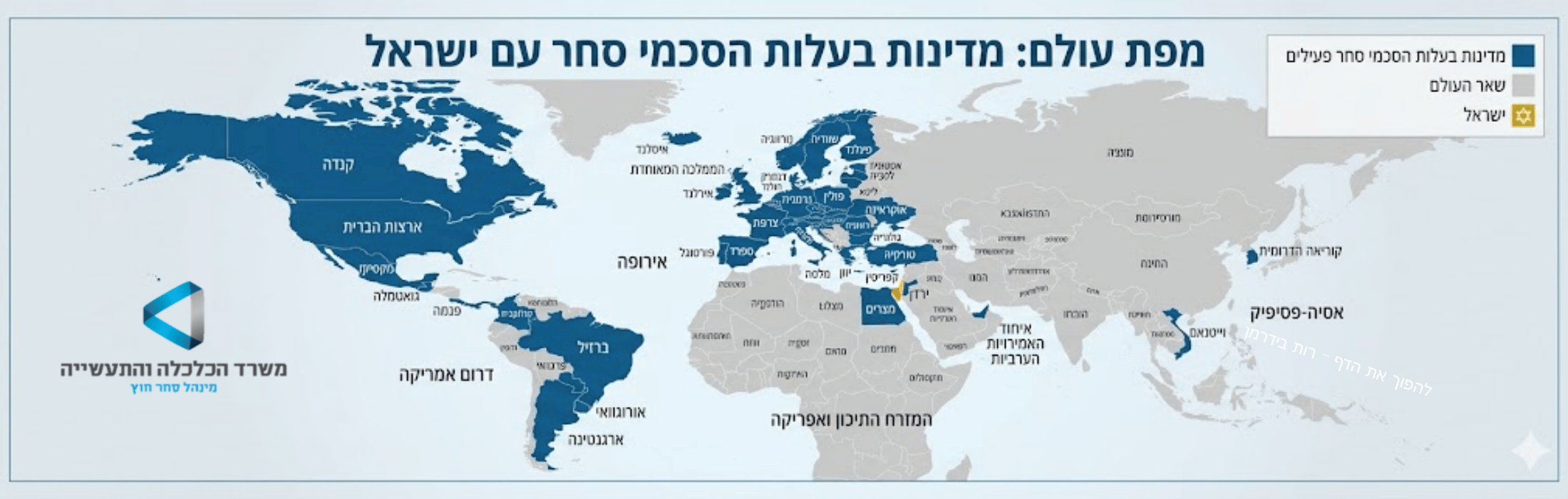
Israel is not directly involved in the trade war that developed between the US and its trading partners, and it has even reduced the minimal tariffs on American agricultural products. However, the indirect implications are significant: US import tariffs on 28% of Israeli goods exports average less than 7%; the threat to global trade could lead to an economic slowdown, reducing demand for Israeli exports; volatility in financial markets could affect exchange rates and financing costs.
5. Economic Recovery and Its Implications
According to the Bank of Israel Monetary Policy Report, economic activity recovered at a moderate pace in the first half of 2025. The annual growth rate in the first quarter stood at 3.7%, similar to the pre-war growth rate. However, GDP remains about 4% below the long-term trend, a gap explained mainly by supply constraints due to labor shortages.
Implications for shipping: Increased demand for shipping services with the recovery; labor challenges affecting workforce availability in the logistics sector; expected growth of 3.3% in 2025 and 4.6% in 2026, according to Bank of Israel forecasts, signaling continued recovery.
6. Strategic Recommendations for Import, Export & Shipping Businesses
For Importers: Take advantage of the strong shekel by advancing purchases and closing forex transactions at favorable rates; maximize the potential of the “What’s Good for Europe” reform to reduce costs and release times; use financial tools (hedges) to protect against future volatility.
For Exporters: Look for new markets in developing countries showing interest in trade agreements with Israel; streamline operations to mitigate margin erosion from exchange rates; develop a risk management strategy against exchange rate fluctuations.
For Shipping & Customs Companies: Train staff to adapt to new reforms and changing workflows; expand services to meet evolving client needs; provide financial and regulatory advisory services.
Conclusion
The shipping, import, and export industry in Israel is at a significant crossroads. Shekel strengthening poses a challenge to exporters but an opportunity for importers. Import reforms, along with geopolitical and economic volatility, create a dynamic environment requiring strategic adjustments. Companies that successfully leverage these trends, use appropriate financial instruments, and adapt to changing regulations will be best positioned to navigate and grow through this challenging period.