allenges vs. Import from the Far East
Introduction
The Israeli import market is undergoing significant changes. Many companies are re-examining their international shipping strategies.
Import from Turkey, Greece or Cyprus is becoming an attractive alternative. In contrast, import from the Far East has dominated the majority of activity for years.
The Far East, led by China, accounts for about 60% of many companies’ imports. However, the long and expensive supply chain presents a major challenge for many businesses.
Global maritime trade has changed dramatically in 2024-2026. The Red Sea crisis, the war in Ukraine, and conflicts in the Middle East have altered the rules of the game. Additionally, the imposition of new import tariffs by countries like the United States is impacting the global trade market.
Turkey imposed a trade embargo on Israel starting in May 2024. This embargo has significantly affected the possibilities for direct import from Turkey. This step included halting the issuance of Eur-Med certificates, which allowed customs duty exemptions for Turkish products arriving in Israel via Europe.
Greece and Cyprus, on the other hand, have become central players. The Greek government has encouraged logistics companies to invest in the Port of Piraeus. The port has become a major gateway for goods into Europe, North Africa, and the Middle East.
This article will compare these two import alternatives. We will examine the advantages, challenges, and costs. We will also provide practical tools for making informed decisions.
Advantages of Import from Turkey, Greece or Cyprus
Geographic Proximity and Short Delivery Times
Physical proximity is a very significant advantage. The sailing distance from the Port of Piraeus in Greece to the Port of Ashdod is only about 1,254 kilometers. The voyage takes approximately three to four days.
Short delivery times enable more efficient inventory management. Companies can hold fewer products in stock. They can also react more quickly to changes in demand.
Import from Turkey, Greece or Cyprus offers unprecedented operational flexibility. An order organized on Monday can arrive in Israel by Thursday. This is a significant benefit compared to the long wait times associated with import from the Far East.
Dedicated LCL Services
Go Shipping recently launched an exclusive Less than Container Load service. The service connects Greece, the Balkans, and Israel via the Port of Piraeus. This is a significant development for small and medium-sized businesses.
LCL service allows shipping small quantities at an attractive price. The customer pays only for the volume they use. This is a flexibility not found in import from the Far East, which often requires large volumes.
The service includes collection of goods from across Greece and the Balkan countries. The goods are consolidated at the logistics center in Piraeus. They are then sent weekly to the Port of Ashdod. Upon arrival in Israel, goods can also be forwarded to Haifa.
Significantly Lower Shipping Costs
Shipping costs from Turkey, Greece, or Cyprus are fundamentally lower. The average shipping cost from Piraeus to Ashdod starts at around 500 Euros for a 20-foot container. This is a saving of tens of percent compared to the Far East.
Major shipping lines operate regularly on this route. Companies like Maersk, MSC, Hapag-Lloyd, ONE, and CMA CGM offer weekly service. Intense competition leads to continuous price reductions.
Reduced Reliance on Chinese Ports
Congestion in Chinese ports has become a chronic problem. Delays of weeks are not uncommon. In contrast, the ports of Greece and Cyprus operate with high efficiency.
Import from Turkey, Greece or Cyprus reduces exposure to unexpected delays. This is a critical point in an era of global disruptions. Flexible supply chain planning is possible thanks to geographic proximity.
The Challenges of Import from Turkey, Greece or Cyprus
The Turkish Embargo and Its Consequences
Turkey imposed a trade embargo starting in May 2024. The decision was made against the backdrop of Israel’s war in Gaza. The embargo has seemingly brought direct trade to a halt.
Official Turkish data shows zero trade with Israel since June 2024. The Turkish Ministry of Trade claims the embargo is being fully implemented. However, the situation on the ground is more complex.
The embargo includes preventing ZIM ships from docking at Turkish ports. Vessels owned by Israel or flying an Israeli flag are not permitted to dock. Nevertheless, major companies like MSC and Maersk continue to sail between Turkey and Israel to this day.
Eur-Med Certificates and Customs Difficulties
An even more serious problem concerns Eur-Med certificates. These certificates allow customs duty exemptions for products. Turkey has stopped issuing these certificates to Israel.
This means that even if a Turkish product arrives in Israel via an intermediary country, it will not receive a customs exemption. The certificate must be presented to the Israeli Customs Authority. Without a valid certificate, the importer pays full duty.
The Eur-Med agreement is multilateral, including the EU, Israel, Turkey, and Jordan. The agreement is meant to facilitate trade. However, the Turkish embargo makes its implementation impossible.
Limited Product Range
Import from Turkey, Greece or Cyprus does not fully replace import from the Far East. Turkey does offer a wide range of products. However, in fields like electronics, consumer goods, and technology, the product range is limited.
Greece and Cyprus specialize in more narrow fields. Main products include food, agricultural goods, construction materials, and chemical products. Advanced industrial products, spare parts, and electronics are mainly imported from the Far East.
Regulatory Limitations
The European Union imposes strict regulations on imports and exports. Products coming from Greece and Cyprus must meet stringent European standards. This could create difficulties for some importers.
The Israeli Customs Authority scrutinizes products arriving via indirect routes. There is a concern about smuggling and circumvention of the Turkish embargo. This can lead to additional inspections and delays.
Advantages of Import from the Far East (China, Vietnam, India)
Significantly Lower Purchase Prices
China remains the world’s cheapest manufacturer of goods. Mass production capabilities provide a significant economies of scale advantage. Low labor costs and advanced infrastructure contribute to price reductions.
Price differences between a Chinese product and a European one can reach tens of percent. In many cases, the price difference justifies the long waiting time. For labor-intensive products, there is no real substitute for import from the Far East.
Wide Product Range
The Far East offers the widest range of products in the world. Almost any industrial product can be found in China. From electronics to furniture, from clothing to heavy machinery.
Import from Turkey, Greece or Cyprus is limited to certain fields only. Companies seeking a wide variety of suppliers will continue to turn to the Far East. This is one of the main reasons for China’s dominance in the Israeli import market.
Developing Free Trade Agreements
Israel does not currently have a free trade agreement with China. However, talks are underway to promote such an agreement. These talks are progressing slowly but steadily.
In contrast, Israel has free trade agreements with countries like Vietnam. Other Southeast Asian countries have also signed agreements. The future of trade with the Far East is expected to become more convenient and cheaper.
The Challenges of Import from the Far East
Long Delivery Times
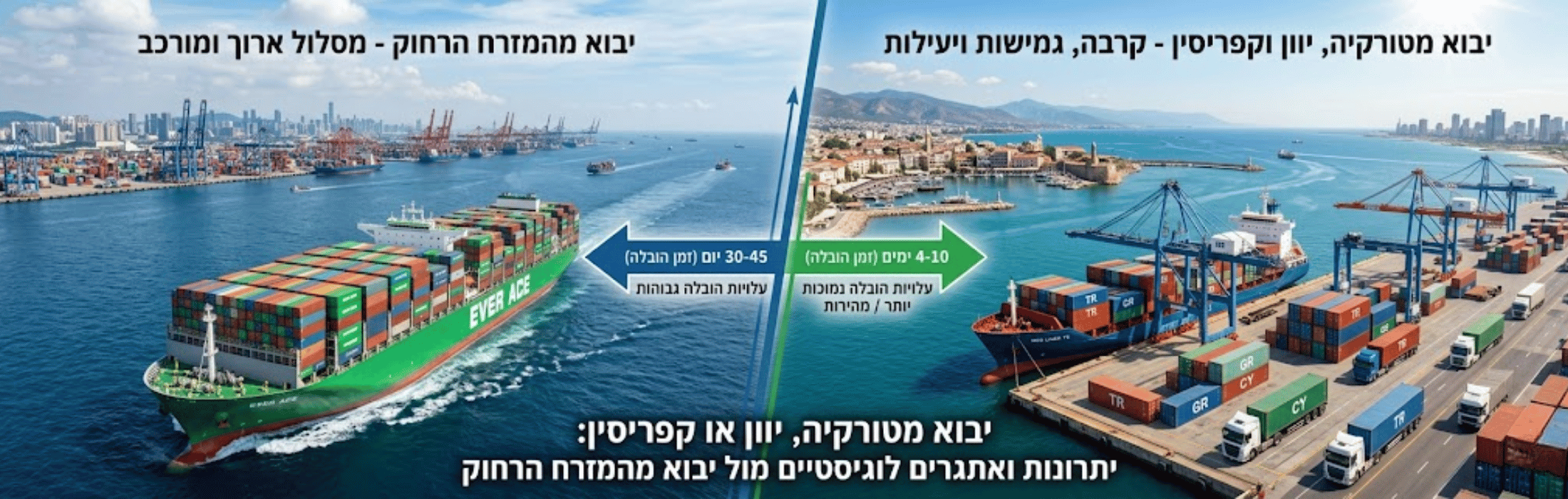
A shipment from China to Israel takes an average of 30-45 days. The Red Sea crisis has significantly extended these times. Companies are forced to hold large inventories and deal with high working capital.
Import from Turkey, Greece or Cyprus takes only 3 to 10 days. The difference in delivery times affects all aspects of business management. Cash flow, market responsiveness, and customer service levels are directly impacted.
Dependence on a Fragile Global Supply Chain
Crises in recent years have exposed the fragility of the supply chain. Port closures in China due to COVID-19 outbreaks paralyzed global trade. The Suez Canal crisis caused months of delays.
Import from Turkey, Greece or Cyprus reduces exposure to global crises. Geographic proximity allows the use of diverse alternatives. In case of a crisis in Greece, shipments can be routed through Cyprus or Turkey.
High and Uncertain Shipping Costs
Maritime transport from China covers a distance of about 12,000 kilometers. Fuel, insurance, and maintenance costs are accordingly high. Furthermore, these costs are highly volatile.
During crisis periods, shipping prices can surge by tens or even hundreds of percent. This makes long-term financial planning difficult. Many companies are forced to bear unexpected costs.
Comparison Table: Import from Turkey/Greece/Cyprus vs. Import from the Far East
Practical Solutions for Overcoming Challenges
Indirect Use of the Turkish Embargo
Despite the embargo, Turkish products still reach Israel. Many companies use indirect routes. One method is transferring goods through Jordan. Jordan imports from Turkey and transfers to Israel.
Another route goes through Egypt, Greece, or Slovenia. Shipping lines exchange bills of lading at intermediate ports. This method allows legal circumvention of the restrictions. However, the intermediate costs make the process more expensive.
DHL launched a new multi-modal route. The route combines sea and land transport via the Port of Piraeus. This solution offers higher speed than the Far East. It is a promising alternative for bypassing the embargo.
Strategic Combination of Supply Sources
The optimal solution is diversifying supply sources. Smart companies combine import from the Far East for large purchases. Simultaneously, they use import from Turkey, Greece or Cyprus for small and urgent purchases.
The dual import strategy allows balancing price and flexibility. Best-selling products are imported from China in large quantities. Niche or urgent products come from the nearby region.
This combination significantly reduces risks. If one route is blocked, the other remains active. The business continues to function even during crises.
Utilizing Eur-Med Certificates for Some Products
Despite the embargo, some products are still eligible for customs exemptions. These are mainly products originating in Europe. Products that have undergone significant processing in Europe can receive an Eur-Med certificate.
The concept of cumulation allows accumulating origin from several countries. For example, a product made in Turkey, transferred to Europe for further processing, and now imported to Israel – may be eligible. The process is complex and requires professional guidance.
Summary
Import from Turkey, Greece or Cyprus offers significant advantages in times of crisis. Geographic proximity enables short delivery times and operational flexibility. Shipping costs are low, and the low risk of delays is a major advantage.
However, the challenges are not negligible. The Turkish embargo complicates direct import and complicates processes. The limited product range and European regulation pose obstacles.
Import from the Far East remains essential for many products. Low prices and wide variety are not easily replaceable. However, long delivery times and dependence on a fragile global supply chain are significant drawbacks.
Our recommendation is to adopt a hybrid import strategy. A proper combination of both routes allows businesses to enjoy the benefits of each world. Diversification reduces risks and improves the ability to respond to crises.
United (Yachdav) invites you to consult with us. Our expert team will help you choose the optimal strategy for your needs. Tailoring import solutions to your business needs is the key to success in today’s competitive market.