


תקציר
31.9% of Israel’s imports came from the EU, and 25.6% of the country’s exports went to the EU.Total trade in goods between the EU and Israel in 2022 amounted to €46.8 billion. The EU and IsraelTrade relations between the EU and Israel are governed by a Free Trade Area that is part of the 2000 EU-Israel Association Agreement.Negotiations to open up additional agricultural trade between the EU and Israel were concluded in 2008. It facilitates bilateral trade, removes trade barriers and provides mutual recognition of…
- The legal basis for the EU’s trade relations with Israel is the EU-Israel Association Agreement, which entered into force in June 2000. The agreement aims to provide an appropriate legal and institutional framework for political dialogue and economic cooperation between the EU and Israel.
Trade picture
- Israel is the EU’s 25th biggest trade partner, representing 0.8% of the EU’s total trade in goods in 2022. It is also among the EU’s main trading partners in the Mediterranean area.
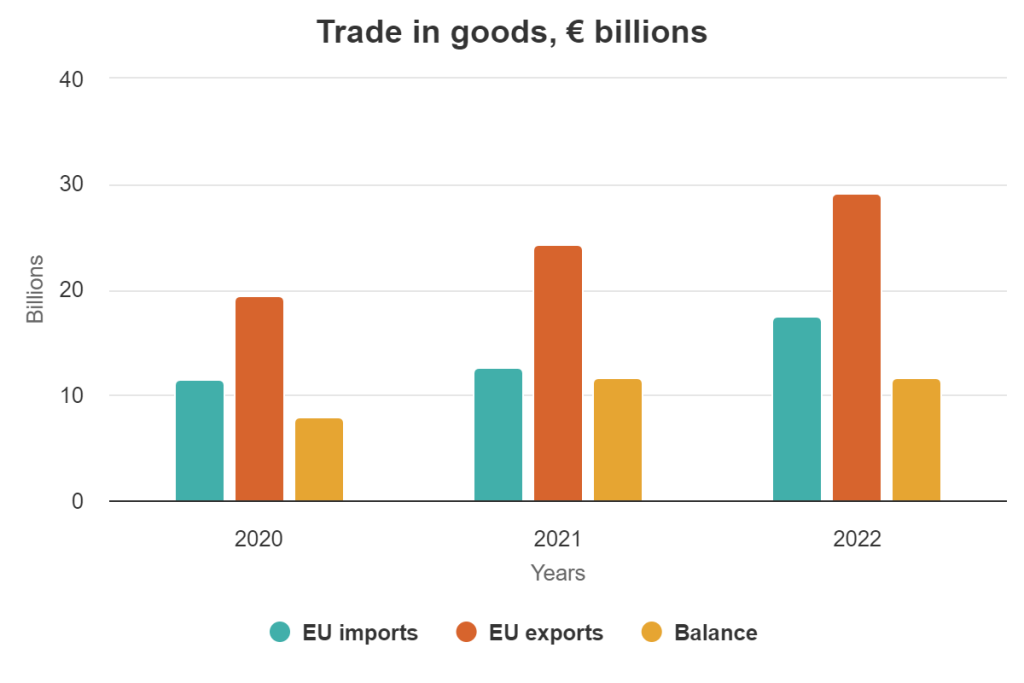
- The EU is Israel’s biggest trade partner, accounting for 28.8% of its trade in goods in 2022. 31.9% of Israel’s imports came from the EU, and 25.6% of the country’s exports went to the EU.
- Total trade in goods between the EU and Israel in 2022 amounted to €46.8 billion. The EU’s imports from Israel were worth €17.5 billion and were led by machinery and transport equipment (€7.6 billion, 43.5%), chemicals (€3.5 billion, 20.1%), and other manufactured goods (€1.9 billion, 11.1%). The EU’s exports to Israel amounted to €12.2 billion and were dominated by machinery and transport equipment (€12.3 billion, 41.9%), chemicals (€5.1 billion, 17.6%), and other manufactured goods (€3.5 billion, 12.1%).
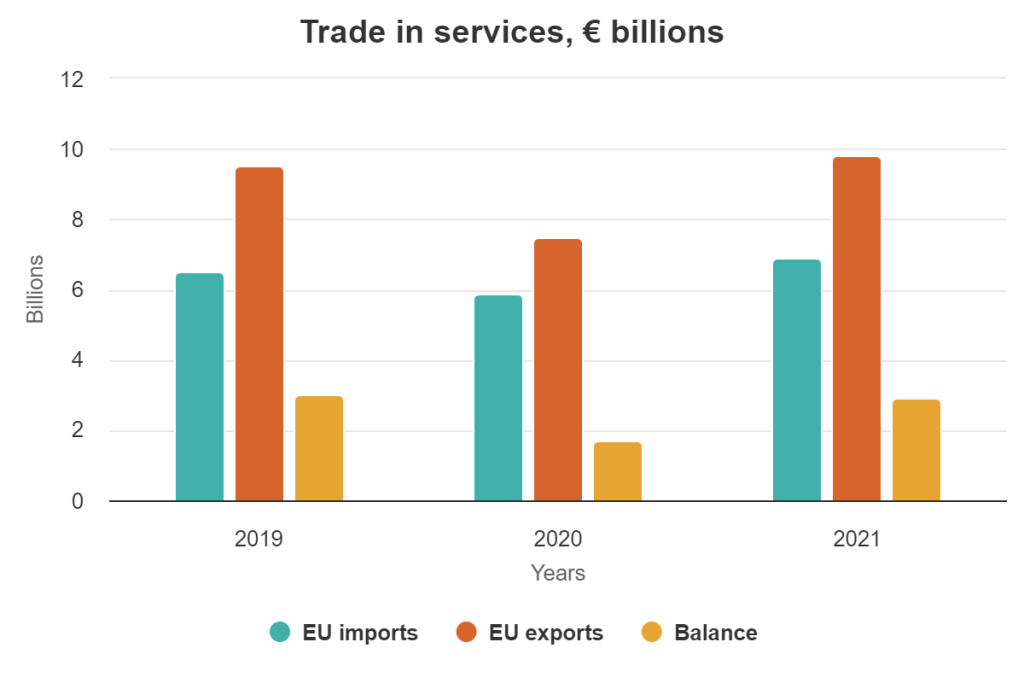
- Two-way trade in services between the EU and Israel amounted to €16.7 billion in 2021. EU imports of services represented €6.9 billion, while exports accounted for €9.8 billion.
The EU and Israel
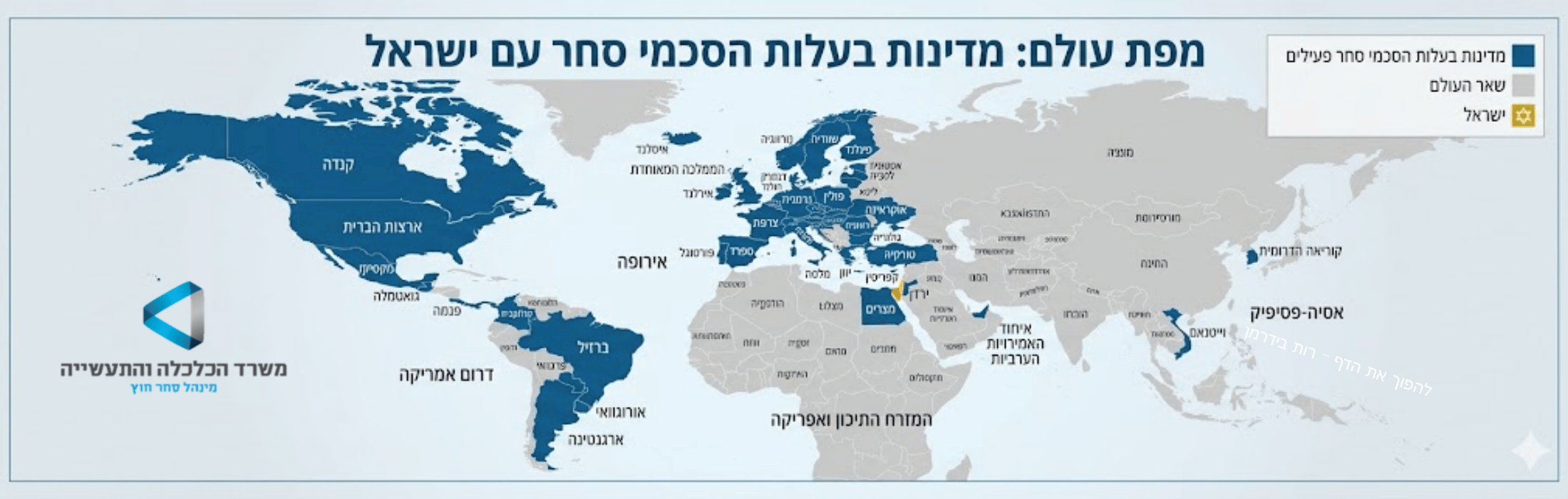
Trade relations between the EU and Israel are governed by a Free Trade Area that is part of the 2000 EU-Israel Association Agreement.
Negotiations to open up additional agricultural trade between the EU and Israel were concluded in 2008. That agreement has been in force since January 2010.
In 2012, the EU and Israel concluded an Agreement on Conformity Assessment and Acceptance of Industrial Products (ACAA) in pharmaceuticals. It facilitates bilateral trade, removes trade barriers and provides mutual recognition of pharmaceutical certification.
Trade and economic relations between the EU and Israel are further enhanced by the Euro-Mediterranean Aviation Agreement (the so-called ‘Open Skies’ aviation agreement), which fully entered into force in 2018 and further opened EU-Israel air travel.
February 2021’s EU Trade Policy Review stated that the EU will propose a new sustainable investment initiative to interested partners in Africa and the EU’s Southern Neighbourhood. Fostering strategic interdependencies and enhancing the EU’s relations and economic integration with its Southern Neighbourhood is a strategic necessity for long-term regional stability.
Financial support
- The European Neighbourhood Policy provides political and financial assistance to Israel. Due to Israel’s advanced level of economic development, EU funds under the European Neighborhood Instrument (ENI) are mostly used for twinning and public administration (TAIEX) projects in the areas of education, telecommunication and water management. On average, this amounts to €1.8 million per year.
- Under the EU’s Multiannual Financial Framework for the period 2021-2027, the EU will adopt a broad new financial cooperation instrument: the Neighbourhood, Development and International Cooperation Instrument (NDICI). The NDICI will replace ENI and contribute to future EU-Israel cooperation.
- More information on EU support is available from the Directorate-General for Neighbourhood and Enlargement Negotiations.
Israel in the Southern Neighbourhood
Israel is one of the partners of the EU’s Southern Neighbourhood (Algeria, Egypt, Israel, Jordan, Lebanon, Libya, Morocco, Palestine*, Syria and Tunisia). The EU established its privileged partnership with the countries of the Eastern and Southern shores of the Mediterranean back in 1995 with the launch of the Euro-Mediterranean Partnership at the Barcelona Conference, aiming to establish an area of peace, stability and economic prosperity that upholds democratic values and human rights.
The 25th anniversary of the Barcelona Process in November 2020 was an opportunity to reflect on the strategic partnership with the region in light of the political, socioeconomic, financial and environmental challenges exacerbated by the Covid-19 pandemic, and to reassess the EU’s partnership with Israel and other Southern Neighbourhood partner countries. Following consultations with partners, this reflection resulted in the Joint Communication by the European Commission and the High Representative of the Union for Foreign Affairs and Security Policy on ‘A renewed partnership with the Southern Neighbourhood – A new Agenda for the Mediterranean‘ and the annexed ’Economic and Investment Plan for the Southern Neighbours‘ in February 2021.
More information on the Southern Neighbourhood
The pan-Euro-Mediterranean cumulation and the PEM Convention on rules of origin
The pan-Euro-Mediterranean cumulation system of origin was created in 2005. It brings together the EU, Israel, and other partners in Europe and the Mediterranean to support regional integration by creating a common system of rules of origin. Rules of origin are technical criteria which determine whether a specific product qualifies for duty-free or other preferential access under a given trade agreement.
Cumulation of origin means a product coming from one partner country can be processed or added to a product of a second partner country and still be considered an ‘originating product’ of that second partner country for the purposes of a particular trade agreement.
The pan-Euro-Mediterranean system allows for diagonal cumulation (i.e. cumulation between two or more countries) between the EU, EFTA countries, Turkey, the Western Balkans, the Faroe Islands, Ukraine, Moldova, Georgia, and any country that signed the Barcelona Declaration of 1995. The system was originally based on a network of Free Trade Agreements with identical origin protocols.
These individual origin protocols are being progressively replaced by a reference to the Regional Convention on pan-Euro-Mediterranean preferential rules of origin (PEM Convention), which was established in 2011 to provide a more unified framework for origin protocols. Israel signed the Regional Convention on 10 October 2013, and it has also ratified it.
More information on Mediterranean preferential Rules of Origin
Trading with Israel
- Importing into the EU from Israel
- EU trade defence measures on imports from Israel
- Exporting from the EU to Israel
- Trade relations are part of the EU’s overall political and economic relations with Israel
- Israel is a member of the World Trade Organization
* This designation shall not be construed as recognition of a State of Palestine and is without prejudice to the individual positions of the Member States on this issue.