





ustoms Brokerage 2026: Regulatory, Technological, and Strategic Acceleration – The Complete Guide to Recent Changes
Introduction: The New Era of Customs Brokerage
The field of customs brokerage, once perceived by many as merely a technical-bureaucratic bridge between importer and port, has been undergoing a true revolution in recent years.
If in the past the role focused on executing cargo release procedures with the authorities, the scope of complexity, regulation, and business risks involved has expanded at an unprecedented rate.
However, while the transformation process has been ongoing for some time, the past month marks a clear turning point: dramatic acceleration on all fronts – from environmental regulation in Europe, through internal reforms in Israel, to the geopolitical impacts on the global supply chain.
In an era where a single regulatory decision can lead to market封锁, and technology changes the rules of the game within months, importers, exporters, and CEOs can no longer rely on old knowledge or familiar practices from the past.
The year 2026 represents a critical juncture where it becomes clear that customs brokerage has long ceased to be a technical service for cargo release.
In practice, it has consolidated into a strategic domain that serves as a central component in every organization’s risk management.
It involves the ability to understand a complex international regulatory mosaic, manage volatile logistics costs, cope with environmental transparency requirements, and navigate rapidly changing global trade constraints.
The new role of the customs broker, as well as that of international trade departments within organizations, demands systemic thinking, data analysis capabilities, and constant adaptation to changes.
This article aims to provide an in-depth and professional review of the most significant developments in the field of customs brokerage that occurred in the past month, focusing on their direct implications for businesses in Israel.
Alongside the review, we will integrate practical insights for managing new risks, a summary table allowing a quick glance at the overall picture, and analysis based solely on institutional publications and official sources.
The goal is to provide you, dear readers, with the necessary tools to transform customs brokerage from a potential vulnerability into a significant competitive advantage.
What Changed This Month in Customs Brokerage – The Full Picture
Environmental Regulation – CBAM Changes the Game
The past month marked a significant milestone in the implementation of the European Union’s Carbon Border Adjustment Mechanism (CBAM), with the transition to the full financial implementation phase.
If until now we were mainly dealing with reporting obligations, today importers to Europe are actually required to purchase emission certificates and effectively pay for the carbon footprint of imported products.
The implication for Israeli exporters is unequivocal: they are required to provide accurate, verified, and documented data on production processes and associated carbon emissions.
Failure to meet these requirements is not just a matter of additional financial cost; it can lead to heavy fines, significant delays at destination ports, and in extreme cases, even complete封锁 of access to the European market.
In this context, the role of the customs broker has expanded significantly, and they are now required to understand ESG metrics (Environmental, Social, and Governance), collaborate with environmental consultants, and become a key advisory factor for the exporter.
Import Reforms in Israel – Responsibility Shifts to the Importer
Alongside global developments, the Israeli customs arena continues to undergo change under advanced reforms, particularly under the leading principle of “What’s good for Europe is good for Israel.”
On one hand, these reforms have led to significant acceleration in release processes, reduced bureaucracy, and eased the flow of goods.
However, on the other hand, they have placed a heavier burden of responsibility on the importer’s shoulders.
Regulatory relief does not come without a price; responsibility for product compliance, adherence to standards, and accuracy of customs declarations shifts unequivocally to the importer.
This means that mistakes that were not caught in the past, or were considered marginal, can now lead to significant administrative sanctions, financial penalties, and even legal claims.
The importer becomes the first and last guardian of the chain’s integrity.
Increased Oversight on Small Parcels
The eCommerce revolution is facing a new regulatory challenge.
In many European countries, particularly in the EU and the UK, it was decided to tighten oversight and impose new taxes, customs duties, and handling fees on small, low-value packages that previously enjoyed exemptions.
This move fundamentally changes the operating model for many businesses based on direct personal imports.
The expected costs, combined with stringent reporting requirements, threaten to erode the high profitability that characterized the sector.
In Israel, although the implementation of these changes has not yet been fully completed, the expectation is that a similar regulatory adjustment will occur in the near future.
Online importers and commerce platforms must prepare in advance for this anticipated change, both in pricing and in their logistical model.
The Impact of the Security Situation on Customs Brokerage
The past month was characterized by renewed escalation in key shipping routes, including the Red Sea area, which had an immediate and severe impact on global supply chains.
The consequences are strongly felt in the customs brokerage industry: transit times have significantly lengthened due to route changes; shipping costs (maritime transport) have soared; and insurance companies have raised premiums or reduced coverage due to the increased risk.
It is important to understand that increased shipping costs directly affect the CIF value (Cost, Insurance, Freight), which is the basis for calculating customs duties and VAT in Israel.
Consequently, not only do logistics costs rise, but also the amount of taxes paid to the authorities.
In this situation, flexible logistical planning, diversification of supply sources, and ongoing risk management have become more critical than ever, and are an integral part of the professional customs broker’s work.
The Shift to Digitalization – The Future is Already Here
Digitalization is no longer a vision for the future, but an accelerated reality reshaping the field of customs brokerage.
The transition to electronic Bills of Lading (eBL) is gaining momentum, replacing heavy physical documents, while shortening timelines and reducing human errors.
Simultaneously, there is increasing use of artificial intelligence for analyzing risk data, identifying anomalies in reports, and even predicting possible delays in the supply chain.
Real-time monitoring systems now allow tracking goods from the moment they leave the factory until they arrive at the warehouse, with full transparency towards all parties.
As a result, businesses that do not adopt advanced technological tools may find themselves at a significant competitive disadvantage.
A customs broker in the current era is required not only to know the law, but also to master complex digital systems, analyze data, and use it for strategic decision-making.
Summary Table – Customs Brokerage News This Month
| No. | Area | Key Change | Business Impact | Risk Level |
|---|---|---|---|---|
| 1 | Environmental Regulation | CBAM mechanism enters full payment phase | Significant increase in export costs to Europe; demand for accurate ESG data | High |
| 2 | Israeli Imports | Expansion of “What’s good for Europe” reforms | Full responsibility transferred to importer; increased exposure to fines and lawsuits | High |
| 3 | eCommerce | Imposition of taxes and fees on small packages in Europe | Erosion of profitability; change in personal import business model | Medium |
| 4 | Geopolitics & Security | Delays and increased shipping costs due to escalation on shipping routes | Rise in CIF value; increased tax costs; impact on inventory availability | High |
| 5 | Technology | Accelerated shift to eBL, AI, and real-time monitoring | Competitive advantage for adopters; risk of competitive drop-out for resisters | Low |
| 6 | Law & Transparency | Stricter transparency and reporting obligations towards customs authorities | Exposure to class actions and administrative enforcement in case of inaccuracies | Medium |
The Role of the Customs Broker – What Has Actually Changed
The shift from operational to strategic management is most clearly reflected in the role of the customs broker itself.
In the past, their role was defined primarily as executional: submitting forms, classifying goods, and coordinating with customs authorities.
In contrast, today the role has expanded and become multi-dimensional.
A professional customs broker is now required to be an expert in managing evolving regulations, a commercial advisor assisting in identifying new markets and alternative trade routes, and a risk manager steering the company away from legal and financial pitfalls.
The required capabilities today include a deep understanding of ESG areas, advanced logistics, data analysis, and even familiarity with financial tools for dealing with volatility in exchange rates and shipping costs.
Choosing a customs broker is no longer a minor technical decision, but a critical strategic determination affecting the company’s stability and its ability to grow in international markets.
Key Risks for Importers and Exporters
Analyzing the presented changes allows us to identify several key risks with the potential for substantial harm to businesses.
First, the regulatory risk: errors in product classification, non-compliance with import standards, or inaccuracies in CBAM reports can lead to extremely heavy financial penalties, potentially jeopardizing the viability of the entire transaction.
Second, the commercial risk: failure to meet international standards or continuous supply delays can lead to loss of customer trust, reputational damage, and even exclusion from new markets.
Third, the financial risk: unexpected costs due to volatility in shipping prices, unplanned regulatory changes, or devaluation of local currency can severely impact the organization’s operational profitability.
Faced with these risks, professional and continuous risk management, combining internal expertise with external consulting, becomes a necessity, not an option.
How to Prepare Properly for Changes
To successfully cope with the complex and changing international trade environment, businesses must adopt a proactive and structured approach.
The key required steps include:
Conducting preliminary compliance checks: Beyond routine checks, a mechanism of rigorous compliance tests should be established before goods are shipped, adapting to the most current regulatory requirements in the destination country.
Working with a strategic customs broker: The transition from working with a technical provider to a strategic partner is critical. Choose an entity that understands the overall picture, advises, and alerts about future risks, not just performs routine operations.
Implementing advanced digital systems: Investment in supply chain management systems, electronic document management, and data analysis is no longer an expense but a competitive necessity enabling efficiency, transparency, and error reduction.
Ongoing regulatory monitoring: Resources should be allocated for close monitoring of regulatory changes in Israel and worldwide. Staying on top of changes allows for early preparation and prevents regulatory shock.
Additionally, it is recommended to conduct periodic cost analysis covering all chain components (customs duties, VAT, freight, insurance, new regulatory requirements).
Such an approach allows for identifying potential risks at an early stage, pricing them correctly, and preventing heavy losses resulting from unpleasant surprises.
New Opportunities in the Field of Customs Brokerage
Despite the complex challenges and significant risks, the new reality also harbors significant business opportunities for those who know how to navigate it.
First, accelerated digitalization is not just a challenge; it enables significant savings in operational costs, reduced delivery times, and improved customer service, constituting a clear competitive advantage.
Second, in a world where regulation is becoming complex, businesses that invest in understanding and implementing it turn complexity into a barrier to entry for competitors.
They are able to offer their customers greater certainty, the ability to meet deadlines, and access to markets that are closed to less professional competitors.
Furthermore, regulatory and trade changes open doors to new markets, with alternative trade routes and new trade agreements creating opportunities for supply source diversification and expansion of activities.
In this dynamic environment, those who act with strategic thinking, invest in knowledge and technology, and view customs brokerage as a central component of business management – will be able to grow, strengthen their position, and increase their market share.
Professional Summary: From Technical Profession to Managerial Responsibility
The past month in the field of customs brokerage is further evidence of a clear and unequivocal trend: the shift from a narrow operational world to a broad strategic world is not an option, but an existing reality.
The journey of customs brokerage from a side office to one of the important rooms in the organization’s boardroom has been completed.
A look at recent developments – from stringent environmental regulation in Europe, through the transfer of legal and commercial responsibility to the Israeli importer, to the geopolitical and technological impacts on the supply chain – shows that this is a hybrid field requiring systemic, multidisciplinary, and dynamic thinking.
On one hand, regulation is becoming complex, detailed, and with immediate financial consequences; it requires the expertise of a lawyer, an environmental specialist, and an economist combined.
On the other hand, the tools available to professionals are constantly improving, with technologies enabling unprecedented transparency, efficiency, and accuracy.
The particular combination of the pace of regulatory change, technological development, and the uncertain security and geopolitical situation creates a new business environment, one in which the routine of the past is no longer relevant.
Therefore, the conclusion for decision-makers in Israel is sharp and clear: businesses that try to continue operating according to the old paradigm, viewing customs brokerage as a technical expense to be minimized, may quickly find themselves at a disadvantage, exposed to unnecessary risks, and left behind.
In contrast, businesses that recognize that customs brokerage is a central strategic function, invest in knowledge, technology, and professional partnerships, and adopt an approach of continuous risk management – these will be the leaders.
They are the ones who will turn complexity into an advantage, risk into opportunity, and global uncertainty into a stable foundation for growth in Israel and around the world.
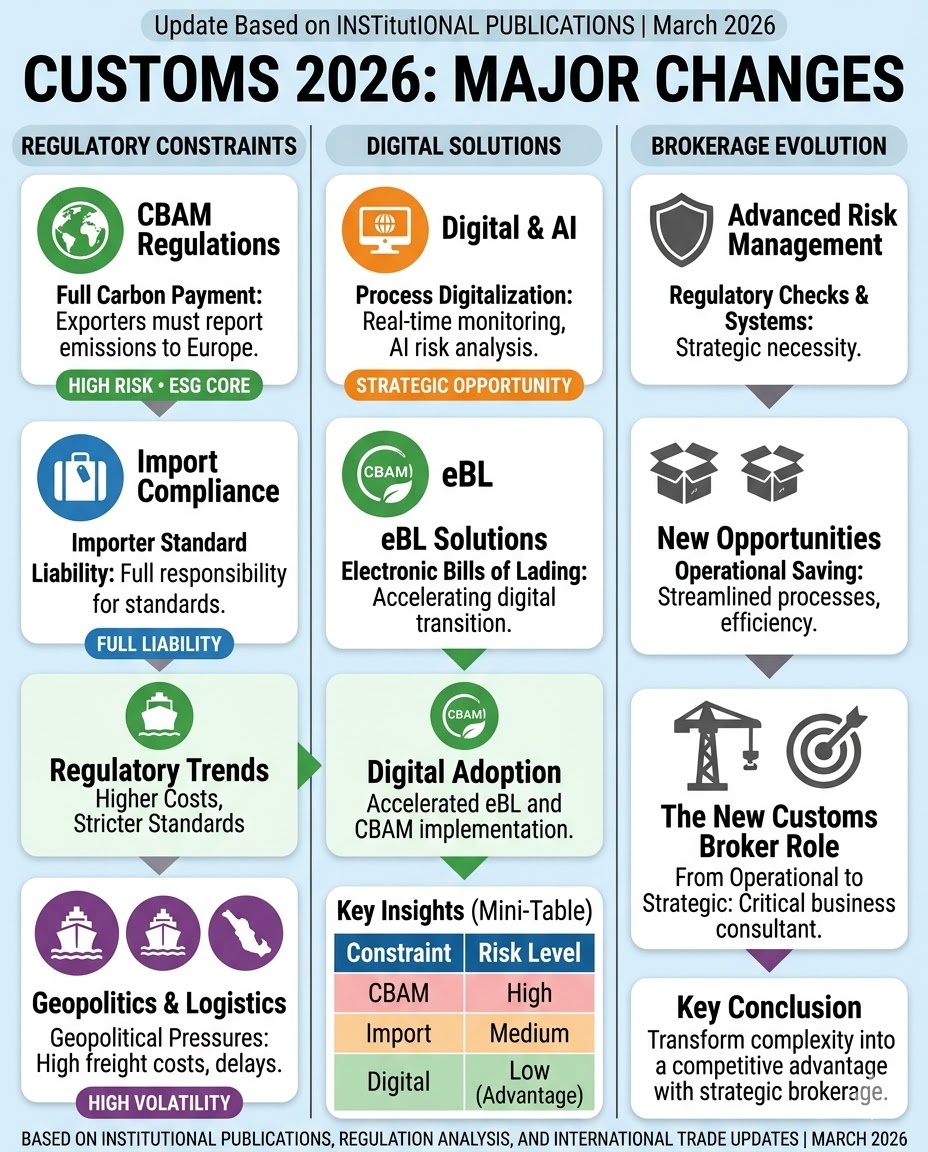
The European Union's Carbon Border Adjustment Mechanism (CBAM) moved to the full financial implementation phase in the past month. This means: importers to Europe are now required to purchase emission certificates for carbon-intensive products (such as iron, steel, cement, aluminum, fertilizer, and electricity). For Israeli exporters, this requires accurate and verified reporting of carbon emissions throughout the production process. Non-compliance can lead to significant financial penalties, delays at destination ports, and in extreme cases – complete封锁 of exports to the European market. Additionally, the role of the customs broker has expanded, and they are now required to understand ESG metrics, collaborate with environmental consultants, and become a strategic advisor for the exporter.
The reforms promoted by the Israel Customs Authority facilitate faster release of goods, but transfer the burden of compliance, classification, and accuracy onto the importer's shoulders. In the past, some inspections were performed by customs; today, the importer is required to ensure full compliance with standards, declarations, and submission of authentic documents. Mistakes once considered minor can now lead to administrative proceedings, heavy fines, and even legal claims. The emphasis is on "self-responsibility" – the importer must conduct comprehensive due diligence, work with a strategic customs broker, and implement internal audit processes to avoid regulatory risks.
In the European Union, the United Kingdom, and other countries, there has been significant tightening: small packages (up to €150) that previously enjoyed exemptions or reduced taxes are now subject to full VAT, customs duties, and handling fees. The eCommerce model is changing rapidly, and expected profitability is eroding. In Israel, the full transition has not yet been completed, but regulatory alignment is expected in the coming years. Businesses based on personal imports need to prepare for rising costs, consider centralized import models (B2B), and update pricing strategies. Collaboration with a customs broker well-versed in eCommerce regulations is becoming critical.
Escalation in the Red Sea, Bab el-Mandeb Strait, and major shipping routes is causing prolonged delays, expensive detours, and a sharp increase in maritime freight costs. Insurance premiums have soared. A direct consequence: the CIF value (Cost, Insurance, Freight) – which serves as the basis for calculating customs duties and VAT in Israel – rises, so taxes themselves increase. Additionally, delivery times lengthen, causing inventory risks. Companies require flexible logistical planning, supply source diversification, and ongoing risk management. A professional customs broker now also integrates expertise in supply chain planning and assessing the tax implications of freight volatility.
Digitalization is accelerating: widespread transition to electronic Bills of Lading (eBL) that shorten processes, artificial intelligence for risk analysis and automatic classification, and real-time monitoring systems throughout the supply chain. These tools enable full transparency, reduction of human errors, immediate anomaly detection, and improved predictive capability. Businesses that do not adopt advanced technology may fall behind, suffer from hidden costs, and lack competitiveness. Customs brokers are now required to be familiar with ERP systems, API interfaces with customs authorities, and analyze data to provide information-based strategic advice.
In the past, the customs broker had an operational role (submitting forms, clearance). Today, it is a strategic role encompassing: management of evolving regulations, commercial advisory, risk management, understanding of ESG areas, and advanced logistics. A strategic customs broker serves as an external consultant assisting in identifying opportunities, reducing penalties, planning organizational structure vis-à-vis customs authorities, and improving cash flow. When choosing a customs broker, one should consider: proven experience in the specific field, use of digital tools, ability to provide professional guidance on CBAM procedures and environmental regulation, and business references. Proper selection is a key factor for operational stability and growth in international markets.
Three main risks can be identified: Regulatory risk – errors in classification, non-compliance with import standards, or incorrect carbon reports can lead to heavy fines and even suspension of the importer's license. Commercial risk – supply chain delays or regulatory non-compliance can cause loss of customers, reputational damage, and blocked access to key markets. Financial risk – volatility in shipping costs, currency fluctuations, and unexpected regulatory changes erode profitability. Effective risk management requires ongoing monitoring, rigorous compliance checks, appropriate insurance, and close work with customs and logistics experts.
Proper preparation includes five key steps: 1) Preliminary compliance checks – beyond routine checks, establish an internal audit mechanism before export/import. 2) Selecting a strategic customs broker – a partner who understands the broader picture, advises, and alerts. 3) Implementing digital systems – investment in eBL, real-time monitoring, and AI for efficiency. 4) Ongoing regulatory monitoring – appointing a responsible party or using alert tools for changes in Israel and worldwide. 5) Periodic cost analysis – including customs duties, VAT, freight, insurance, and new regulatory costs. Adopting a strategic approach turns complexity into a barrier to entry for competitors and creates an advantage in global markets.
Absolutely. Despite the challenges, digitalization enables significant savings in operational costs, shorter delivery times, and improved customer experience. Businesses that invest in understanding complex regulation (CBAM, environmental transparency) can turn it into a unique advantage, offering customers greater certainty and accessing markets closed to less professional competitors. Additionally, global trade changes open new markets and alternative trade routes (such as overland routes or imports from countries with updated trade agreements). Companies that leverage customs brokerage as a strategic tool can actually grow, strengthen their market position, and increase their market share in an era of uncertainty.
The trend is clear: a shift from an operational world to a data-driven strategic world. By 2027, most Bills of Lading are expected to be digital, artificial intelligence will automatically classify and assess risks, and ESG and carbon requirements will become an integral part of customs declarations. Customs authorities will adopt integrated real-time systems, and responsibility for information accuracy will fall entirely on importers and exporters. The customs broker will evolve into the role of "International Trade Risk Manager" and will require deep understanding of data analysis, international law, and sustainability. Organizations that invest in workforce training and advanced technologies will be more resilient and able to successfully navigate global complexity.