









תקציר
When it comes to international shipping of goods, one of the most important decisions you’ll need to make is choosing the right type of shipment: Full Container Load (FCL) or Less than Container Load (LCL). 2.1 Definition of LCL LCL shipping refers to a shipment where a client’s goods share a container with goods from other clients. 2.2 Advantages of LCL Shipping Lower Costs for Small Volumes: Shipping costs are shared among multiple clients based on their cargo volume, making it affordable for small shipments.
Introduction
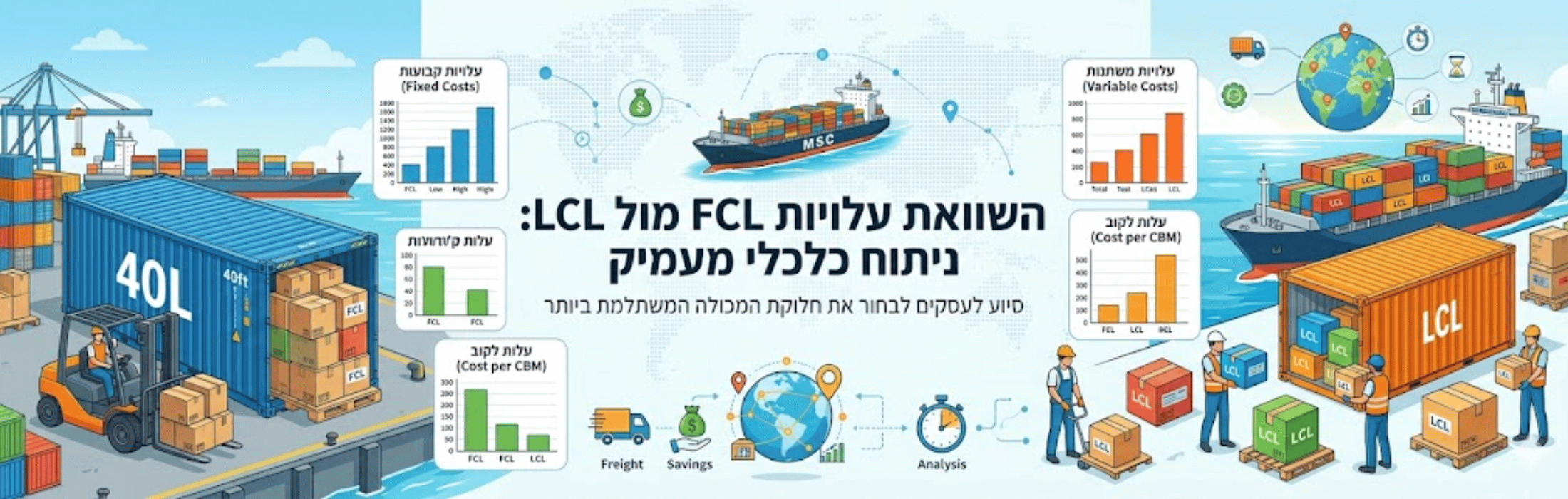
When it comes to international shipping of goods, one of the most important decisions you’ll need to make is choosing the right type of shipment: Full Container Load (FCL) or Less than Container Load (LCL). The difference between these two options affects costs, delivery times, how the cargo is handled, and the overall efficiency of the shipping process.
Understanding the differences between FCL and LCL shipments will help importers and exporters select the best option for their needs, taking into account factors such as the volume of goods, costs, timelines, and the security of the cargo. In this article, we will explore the differences between these types of shipments, the advantages and disadvantages of each, and offer tips on making the right choice.
1. What is FCL (Full Container Load)?
1.1 Definition of FCL
FCL shipping refers to a shipment where the entire container is rented by a single client, without sharing space with goods from other companies. The container can be full or partially filled, as long as it contains only the client’s goods. This type of shipping provides full control over the container, its handling, and unloading.
1.2 Advantages of FCL Shipping
- High Cargo Safety: Since the container belongs to a single client, there is no mixing of goods, reducing the risk of damage, confusion, or loss of items.
- Speed and Efficiency: Handling and waiting times at ports are shorter, as there is no need to coordinate with multiple clients or perform complex loading and unloading procedures.
- Cost-Effective for Large Volumes: When there is enough cargo to fill or nearly fill a container, the cost per individual item decreases significantly.
- Control Over Shipping Process: Provides flexibility in planning schedules and choosing the route.
1.3 Disadvantages of FCL Shipping
- High Cost for Small Volumes: For small shipments, renting an entire container can be expensive and not cost-effective.
- Requires Large Volume of Goods: Best suited for businesses with enough goods to justify a full container.
2. What is LCL (Less than Container Load)?
2.1 Definition of LCL
LCL shipping refers to a shipment where a client’s goods share a container with goods from other clients. Each client pays according to the volume or weight of their goods, making the container space shared among multiple clients as needed.
2.2 Advantages of LCL Shipping
- Lower Costs for Small Volumes: Shipping costs are shared among multiple clients based on their cargo volume, making it affordable for small shipments.
- Flexibility in Cargo Volume: No need to fill an entire container, making it suitable for businesses with varying or smaller quantities of goods.
- High Accessibility and Frequency: Allows frequent shipments of smaller quantities, enabling a continuous flow of goods.
2.3 Disadvantages of LCL Shipping
- Longer Shipping Times: The process can take longer due to the need for collection, splitting, and organizing goods within the shared container.
- Higher Risk of Damage: Mixing goods from different clients increases the risk of damage, confusion, or loss of small items.
- Dependence on Other Parties: Sharing the container with multiple clients requires coordination between various companies, which can lead to unexpected delays.
3. How to Choose Between FCL and LCL?
3.1 Considerations of Volume and Weight
The decision depends on the amount of cargo you have. If your cargo occupies at least half of the container, it is often more cost-effective to choose FCL. For smaller quantities, LCL is the better option.
3.2 Cost Considerations
For small shipments, renting a full container may be costly. However, you should also consider the additional costs associated with LCL, such as extra handling time and potential damages. It’s important to compare the overall costs, not just the direct shipping price.
3.3 Safety and Security Considerations
If you are shipping sensitive or high-value goods, FCL provides greater security and reduces the chance of damage or loss.
3.4 Time and Availability Considerations
FCL shipping is faster since there is no need to wait for additional cargo to fill the container and no need for complex loading and unloading. If availability and speed are important, FCL may be the better choice.
Table: Comparison Between FCL and LCL Shipments
| Criterion | FCL (Full Container Load) | LCL (Less than Container Load) |
|---|---|---|
| Cost | Cost-effective for large volumes, expensive for small volumes. | Affordable for small volumes, cost based on volume or weight. |
| Shipping Time | Fast and efficient, no delays from other parties. | May take longer due to shared container coordination. |
| Safety | High safety, low risk of damage. | Higher risk of damage due to mixing with other goods. |
| Control Over Shipment | Full control over the container and shipping process. | Dependence on other parties, less control over shipping. |
| Flexibility in Volume | Requires a large amount of goods to fill a container. | Suitable for smaller or varying amounts of goods. |
Conclusion
Choosing between FCL and LCL shipping depends primarily on the volume and weight of your cargo, budget, time requirements, and the need for cargo security. FCL is suitable for those importing or exporting large volumes who need high safety and full control over the shipment. On the other hand, LCL is ideal for those importing smaller volumes who want to benefit from the lower costs of shared containers.
Both shipping types provide flexibility and convenience in different ways, so it’s important to understand the advantages and disadvantages of each option. It is recommended to consult with a freight forwarding and customs brokerage company to make the best decision that meets your shipping needs optimally.